


Introduction to BPMN Swimlanes
Business Process Model and Notation (BPMN) is a standardized graphical notation that provides a method to visualize business processes in a workflow. One of the key features of BPMN is the use of swimlanes, which help organize and clarify the roles and responsibilities of different participants in a process. This guide will explore the concept of swimlanes, their structure, and how to effectively use them in BPMN diagrams.
Understanding Pools and Swimlanes
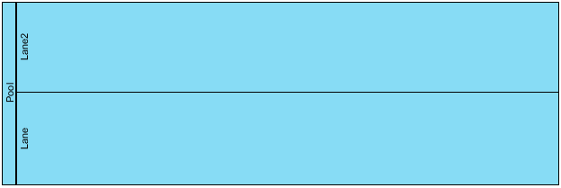
In BPMN, a pool represents a participant in a collaboration, which can be a company or a role within a company. Each pool can contain one or more lanes, which are used to further delineate responsibilities among different roles, systems, or departments.
Key Characteristics of Pools:
- Participants: Pools represent business-to-business collaborators, which can be companies or specific roles within a company.
- Process Control: Participants control the execution of a process, defining when it starts and ends, and establishing the boundaries of the process.
- White Box vs. Black Box:
- White Box Pools: Display process details, including sequence flows and activities.
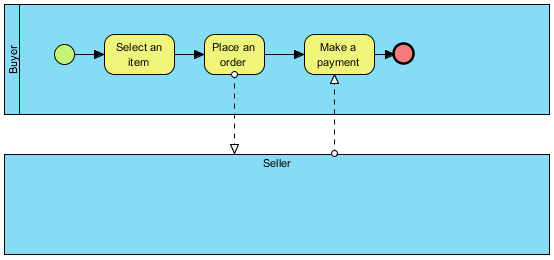
- Black Box Pools: Hide process details, showing only the participant’s identity.
Example of a Pool with Process Details
A white box pool might represent a company’s order processing department, detailing the steps involved in processing an order, such as receiving the order, checking inventory, and shipping the product.
Example of a Black Box Pool
A black box pool could represent a supplier in a supply chain process, where the internal workings of the supplier’s process are not disclosed, but the interaction points (message flows) with the ordering company are shown.
Lanes: Organizing Activities
Lanes within a pool help identify who is responsible for specific activities. They can represent various entities, such as roles, systems, or departments.
Types of Lanes:
- Roles: Specific job titles (e.g., Supervisor, Accountant).
- Systems: Software or tools used in the process (e.g., CRM System).
- Departments: Organizational units (e.g., Sales, Shipping).
Example of Lanes in a Pool
In an order fulfillment process, lanes might include:
- Sales Department: Responsible for taking orders.
- Warehouse: Responsible for picking and packing items.
- Shipping: Responsible for dispatching orders.
Sublanes: Further Granularity
Sublanes can be used to provide additional detail within a lane, often representing sub-roles or specific tasks. For instance, within the Warehouse lane, sublanes could represent different roles such as Forklift Driver and Picker.
Orchestration Model
An Orchestration Model describes how a single participant coordinates a set of activities. This model can be likened to a sports team, where a quarterback (the orchestrator) calls the plays and assigns roles to team members.
Example of an Orchestration Model
In a football analogy:
- Pool: Offensive Coordinator (the team).
- Activities: Calling the play, executing the play, scoring a touchdown.
- Sequence Flows: The flow of actions from calling the play to scoring.
Best Practices for Using Swimlanes
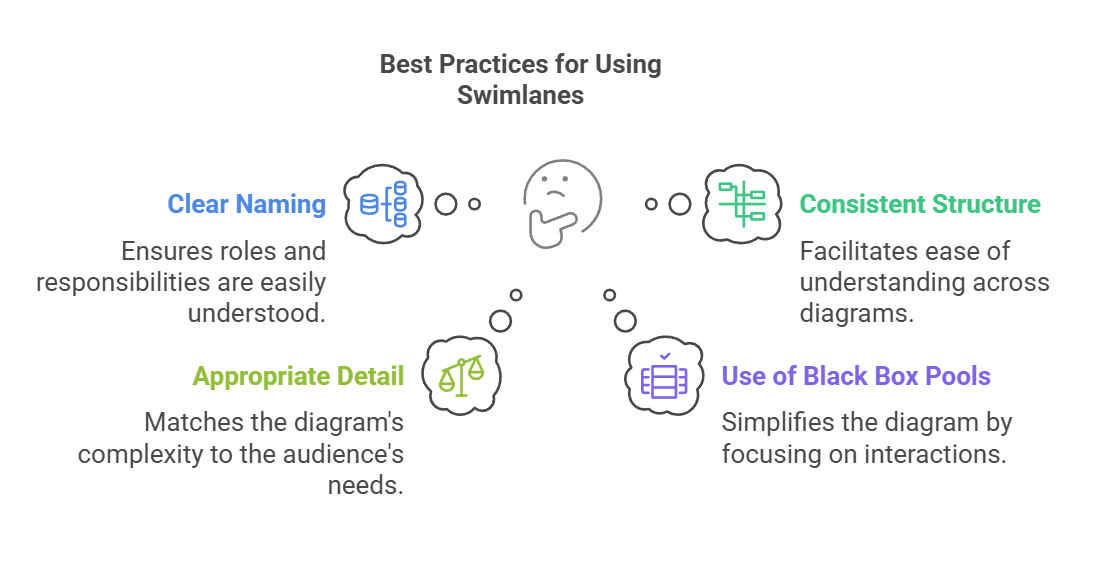
- Clear Naming: Ensure that pools and lanes are clearly named to reflect their roles and responsibilities.
- Consistent Structure: Maintain a consistent structure across diagrams for ease of understanding.
- Appropriate Level of Detail: Choose the level of abstraction based on the audience (high-level overview vs. detailed process).
- Use of Black Box Pools: When details are not necessary, use black box pools to simplify the diagram and focus on interactions.
Conclusion
BPMN swimlanes are a powerful tool for visualizing and organizing business processes. By effectively using pools and lanes, organizations can clarify roles, responsibilities, and interactions, leading to improved communication and efficiency. Whether modeling simple processes or complex collaborations, understanding and applying swimlanes will enhance your BPMN diagrams and facilitate better process management.
BPMN References
- Comprehensive Guide to Visual Paradigm for Business Process Modeling
- Streamlining Business Processes with Visual Paradigm’s BPMN Business Process Modeling Software
- Visual Paradigm: Your Comprehensive Solution for Integrated Enterprise Modeling
- Demystifying BPMN: A Comprehensive Guide to Business Process Modeling
- Navigating Business Processes with BPMN: A Visual Odyssey
- Visual Paradigm: The Ultimate All-in-One Visual Modeling Platform for Enterprise Architecture and Software Design
- Top Visual Paradigm Tools for Business Process Modeling
- Visual Paradigm: The Premier Tool for ArchiMate EA Modeling
- Mastering Visual Paradigm’s BPMN Tool: A Step-by-Step Learning Guide
- Simplify Business Process Modeling with Visual Paradigm’s BPMN Tools
- BPMN — Quick Guide
- BPMN in a Nutshell — with Free Online BPMN Tool & Examples
- A Comprehensive Guide to BPMN
- Modeling As-Is and To-Be Processes
- How to Perform Gap Analysis with BPMN?
- Visual Paradigm: A Comprehensive Suite for IT Project Development and Digital Transformation
Related posts:
 Coordinate BPMN Process Design Sessions with Remote and Distributed Teams
 Define Interaction Patterns Between Organizations with BPMN Choreography Tasks
 Case Study: Optimizing the BPMN Working Group E-mail Voting Process Context and Challenge
 From Concept to Execution: A Comprehensive User Review and Guide to BPMN 2.0 with Visual Paradigm